
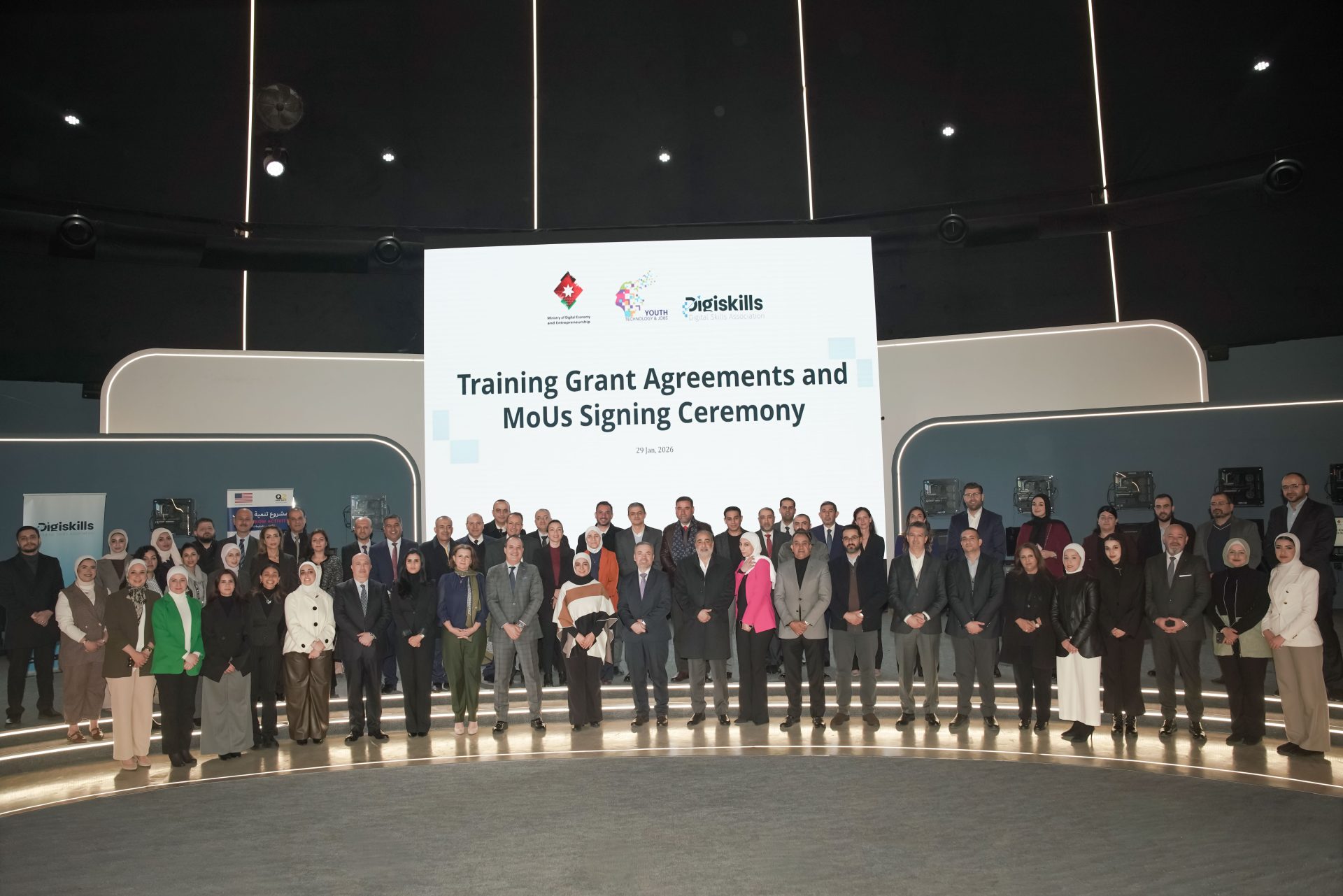
Under the patronage of the Secretary-General of the Ministry of Digital Economy and Entrepreneurship, Ms. Samira Al-Zoubi, representing HE Minister Eng. Sami Semerat, the Digital Skills Association (DigiSkills) hosted a ceremony announcing the signing of training grant agreements and memoranda of understanding (MOUs). The event, organized as part of the Youth, Technology, and Jobs project, aims to equip youth and employees with emerging digital skills required by the labor market, broaden their professional horizons, and enhance their economic participation.
During the ceremony, Ms. Al-Zoubi emphasized that developing digital skills is no longer optional but a national necessity amid rapid changes in the digital labor market. She highlighted the Ministry’s efforts, through the Youth, Technology, and Jobs project, to align training programs with actual market needs and transform investment in skills into tangible, sustainable employment opportunities, particularly across the governorates.
The event featured the announcement of training grant agreements with 14 private-sector operators and training service providers, targeting over 1,100 young men and women across the Kingdom. These programs focus on workplace training, digital skills development, and employment promotion, contributing to preparing youth for high-quality job opportunities in the digital sector.
Additionally, four strategic MOUs were signed with local and international partners to support career and freelance pathways, connect program graduates with digital job opportunities locally and regionally, facilitate access to funding, and align acquired skills with the evolving needs of the market.
The announcement also included MOUs with six universities and community colleges, aiming to strengthen partnerships with the academic sector, align higher education outputs with the digital labor market, and develop curricula that meet the requirements of the digital economy and future skills. This brings the total number of universities and colleges collaborating under this framework to 28 institutions nationwide.
Ms. Al-Zoubi noted that the agreements reflect a practical implementation of national studies on digital skills gaps, guiding training programs toward the skills genuinely demanded by the labor market, achieving a tangible impact on employment and income opportunities. She stressed that these achievements are the result of true collaborative efforts between the Ministry, private sector, universities, and funding entities, supporting the development of a sustainable digital skills ecosystem.
For his part, Dr. Alaa Enshiewat, Chairman of DigiSkills Association, affirmed that the agreements announced translate national study findings into practical training programs that enhance youth employability and empower them to compete effectively in the digital labor market.